A Tea Made With Skill
This pawst is for all of you tea lovers. Last time I spoke at length about coffee, and while all the ingredients I listed to enhance your brew work with tea too, I think tea deserves its own piece. Also, I am in fact not a coffee cat, but a huge tea cat nerd. I'll have my morning moka or the world will crumble, but after that it's pretty much tea and only tea. Lots of tea.
If we see coffee as a meowgic pawtion, then of course tea is one too. What I like in particular of these pawtions is how simple, yet powerful, they are. We already drink them throughout the day, all we have to do to make them truly meowgical is focus on our intention as we brew and sip them, and maybe say a few words as we do it. I believe meowgic needs to be practical and available whenever you need it, and so these two are purrfect. Tea, however allows us to go a bit deeper and brew more powerful spells, not just because the list of ingredients you can add is almost infinite, but because there is a way of infusing it with even more mewogic. Let me introduce you to the technique of gongfu tea.

Gongfu cha translates to "skillfully made tea", and is a technique of brewing that allows the flavour of the tea to develop to the fullest. The goal is to brew a tea that is satisfying to both the taste and the soul, a concept which I love. If you are alone, it makes for a very relaxing and meditative experience. If you are with friends, you will chat and bond over the (admittedly long) time it takes to brew and drink.
The gongfu method originated in the Chinese region of Fujian sometimes in the 1700s, but it's still popular today. It is not a ceremony, and shouldn't be confused with the Japanese tea ceremony (chado, "the way of tea"). It also does not have any magical connotations, as far as I know, and I want to make it clear that any reference I will make to magic is my own. The last thing I want is to misrepresent this practice that has become so precious to me! The point is to integrate meowgic into the things we already love and do, so that meowgic itself becomes a sustainable and meaningful practice, rather than a chore. With that said, let me now guide you through the procedure. Because I want to make the subject justice, and also I could yowl about it for days, this will be a miniseries of pawsts. I will first describe the method in a general way and then get into the details of each component.
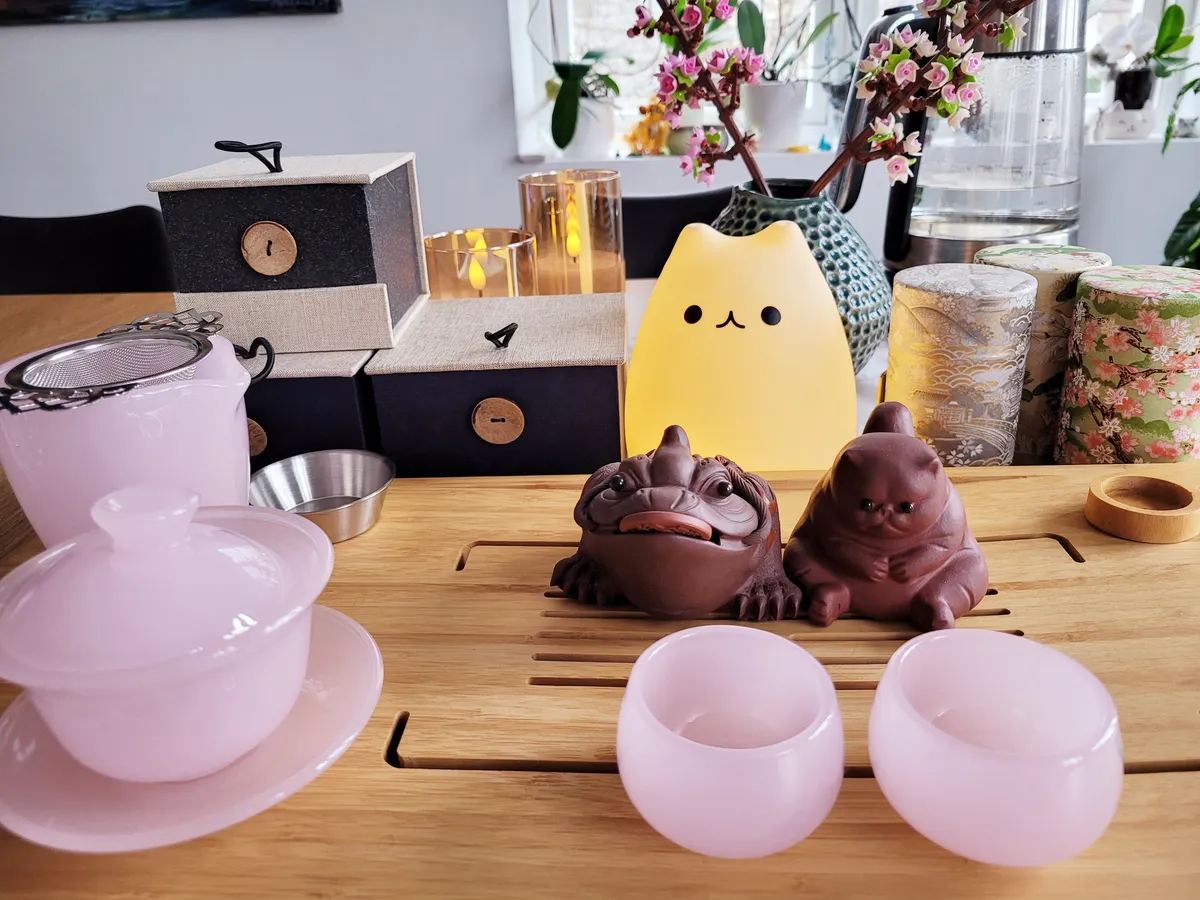
The gongfu method uses a higher leaf-to-water ratio than western-style brewing, but the leaves are steeped for a much shorter time. This allows for the flavour to be intense while preventing the brew from developing bitterness or astringency. Tea of any type can be used, but it should be of good quality; in fact, gongfu is used by tea masters to make their finest tea selections shine. Quality of the water is also important: too many minerals will ruin the taste, but distilled water, on the other hand, will not allow it to develop enough. Source water is the best, and a relatively soft bottled water comes in second place. The water temperature is also very important, and I will cover it later on as it depends on the tea used.
As you can see from the picture, the vessels used are pretty small, which means the tea is brewed in small batches. This is intentional: the same leaves can be reinfused several times, and the whole point is that you keep brewing and sipping, and experiencing the taste as it changes over the infusions. When you are alone, this is one of the best mindfulness practices: notice the sound of the boiling water, see the leaves unfurl and colour seep into the water, then really be aware of the taste in all of its nuances. With friends and loved ones, it offers the opportunity for just sitting there and connecting, with no phones or things to do that make us less present.
This mindfulness is exactly what lends itself so well to meowgic. Gongfu cha can be its own ritual, where you just focus on your desired outcome throughout, or it can be incorporated into a bigger ritual. Light a candle. Paint a sigil with the tea. Fill a second glass for a spirit, deity or ancestor, if that's your thing. I often share a cup with my familiar, which is a spirit. Or share it with friends and/or partners as a love pawtion; the time spent together will do the rest.
Next time I'll talk about all those cute vessels and accessories that are needed for gongfu brewing, and then we'll tackle the star of the whole thing: tea.
May your seat be comfy and your kettle ready.