Paws Off My Pottery!
Last time I introduced the topic of gongfu cha, or brewing tea with skill. Now, as promised, we will take a quick tour into the pottery department, and have a look at the tools we need for this technique.
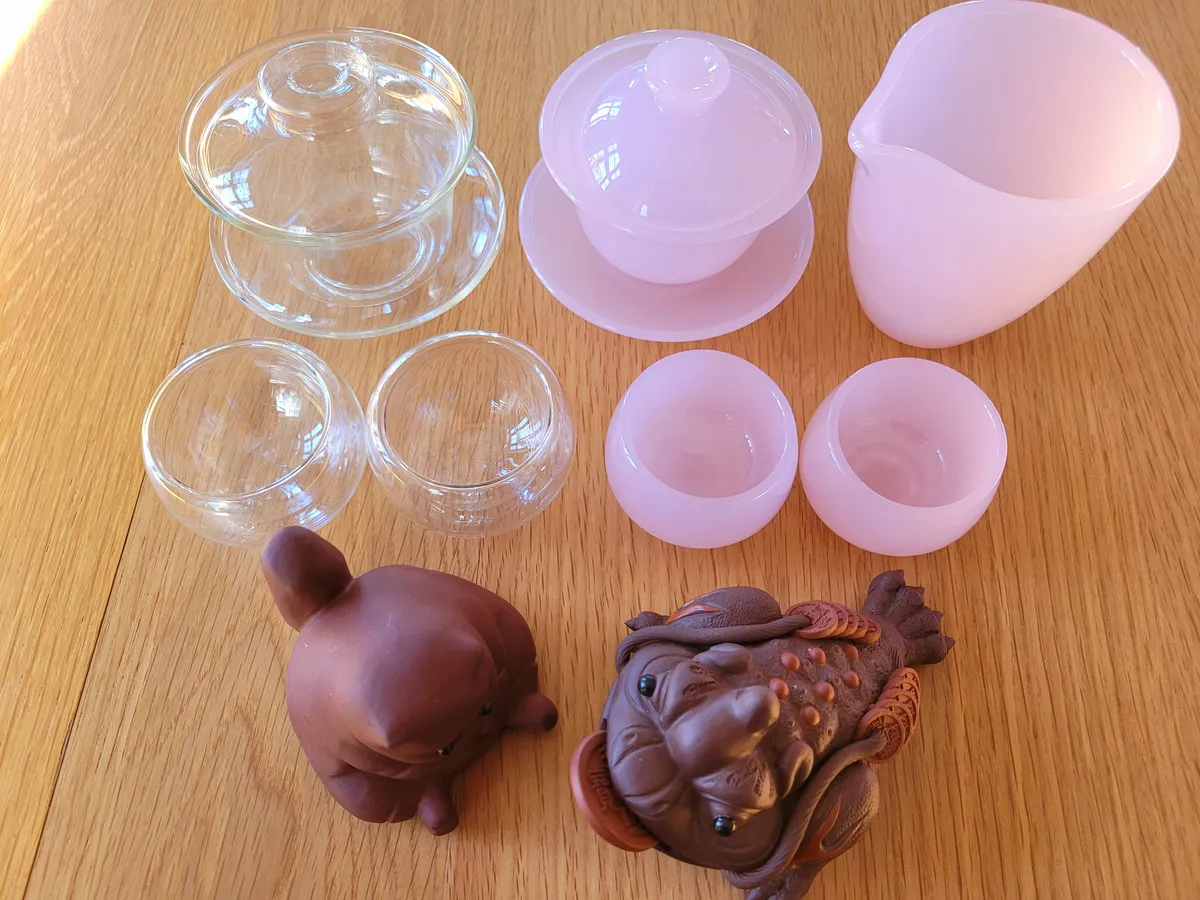
Gaiwan: the gaiwan is the main brewing tool, and probably the only one you really need. It's a small pot with lid that holds the leaves, and where the actual infusion takes place. It also looks a bit like a miniature cauldron, which of course we witches like. Gaiwan are typically made of glass, porcelain or clay.
Glass is the most common material, and also usually the cheapest. The nice thing about it is that it makes the process visible, which is particularly satisfying for tea with whole leaves or flowers. The downside, however, is that it can get very hot and hard to handle.
Porcelain is the stuff of special occasions, although I would argue that brewing a batch of premium-quality tea qualifies as a special occasion.
The clay used for gongfu cha pottery (and generally chinese teawares) is called Yixing clay, from the city where it was historically produced, and still is to this day. The stonewares are left unglazed, which makes them absorb a little bit of tea every time they are used, which in turn makes them retain scent and flavour, and also change colour over time. This is, of course, on purpose: it means that the taste of the brew becomes richer and more complex after using the vessels a few times... provided that said vessels are never washed with soap! Just like the moka coffee machine, as Italians know well. Yixing clay vessels are most often used for pu-erh tea, both because clay doesn't become as hot even at the high temperatures required for this tea, and also because the retaining and mingling of flavours is particularly desired for pu-erh. Of course, this means that if you want to be extra fancy, you should have a whole clay set for raw pu-erh and one for ripe pu-erh1, but ain't nobody got the space for this much pottery  .
.
Cha hai: the cha hai, sometimes also called "Fairness cup", is the pitcher-like vessel in the top right corner of the picture. Its function, and the reason for its alternative name, is to receive the tea from the gaiwan, after the infusion is complete. The process of pouring it from one container to the other stirs and mixes the tea, ensuring that every person receives a brew of the same strength and flavour. It can also be used to let the tea sit there and cool down for a bit, and additionally, the spout makes the pouring easier and less messy. While you can of course buy one made for gongfu cha, any vessel with a spout will do the work.
Cups: again, any cup would technically work for gongfu cha, but the ones that are typically used are very small. I'm pretty sure I've seen bigger shot glasses, but do you know what's about the same size? Glasses used for tasting fancy liquors, and gongfu is exactly that, a tasting of a special tea. The small cup allows the content to cool down fast enough that it can be drank almost straight out of the gaiwan, but also not so fast for the last sips to be cold. Moreover, the gaiwan itself is tiny, given that the whole point of the method is to brew in small batches of concentrated flavour and appreciate the way taste evolves over several infusions; therefore, bigger cups would be pointless.
Glass or white porcelain cups are preferred because they display the colour of the tea most accurately, however I'm a sucker for pink and so that's the set I chose.
Other tools: besides vessels, and obviously a kettle2, here are a few things that will also come handy, while being optional.
Tea tray, for collecting spillage. Gongfu cha trays have a drainer and hidden reservoir for this purpose.
Tea knife, for portioning tea that comes in compacted cakes or bricks.
Strainer, to prevent leaves fragments for ending up in the cups.
Tea mascot, which will be explained in depth in the next pawst.
Towel, because there will be spillage.
Scales or measuring spoon for taking the exact quantity of leaves you want.
A bowl for spent leaves and discarded water.
Brush, used to spread the spilled tea on the tray evenly, so that instead of being stained the tray will develop a nice, uniform patina. Witches also use this to draw sigils with the tea.
Meowgic ritual tools: if this brew is part of a meowgic ritual or spell, feel free to incorporate tools like candles, talismans, tarot cards and the like.
And that's it for now! While tools and vessels don't have much in terms of meowgic properties, they are what allow the actual meowgic components to do their job. And next time we'll talk about something that does bring its own meowgic powers: the tea mascot. Stay tuned!

Does it sound like I'm speaking chinese? Well, yes, but also don't worry: I'll explain everything about tea in one of the next pawsts of the series.↩
Any kettle will do, but an electric kettle with temperature settings is particularly convenient since different teas require different temperatures, and some can be quite sensitive to excessive heat.↩